Why English-Fluency Matters When You Hire Virtual Support
Written by:Remote Leverage
Published:
Updated:
Quick Summary
Not every remote role has the same language requirements, and treating them as if they do is one of the most common mistakes business owners make when they hire a virtual assistant. The right standard depends entirely on what the role actually demands.
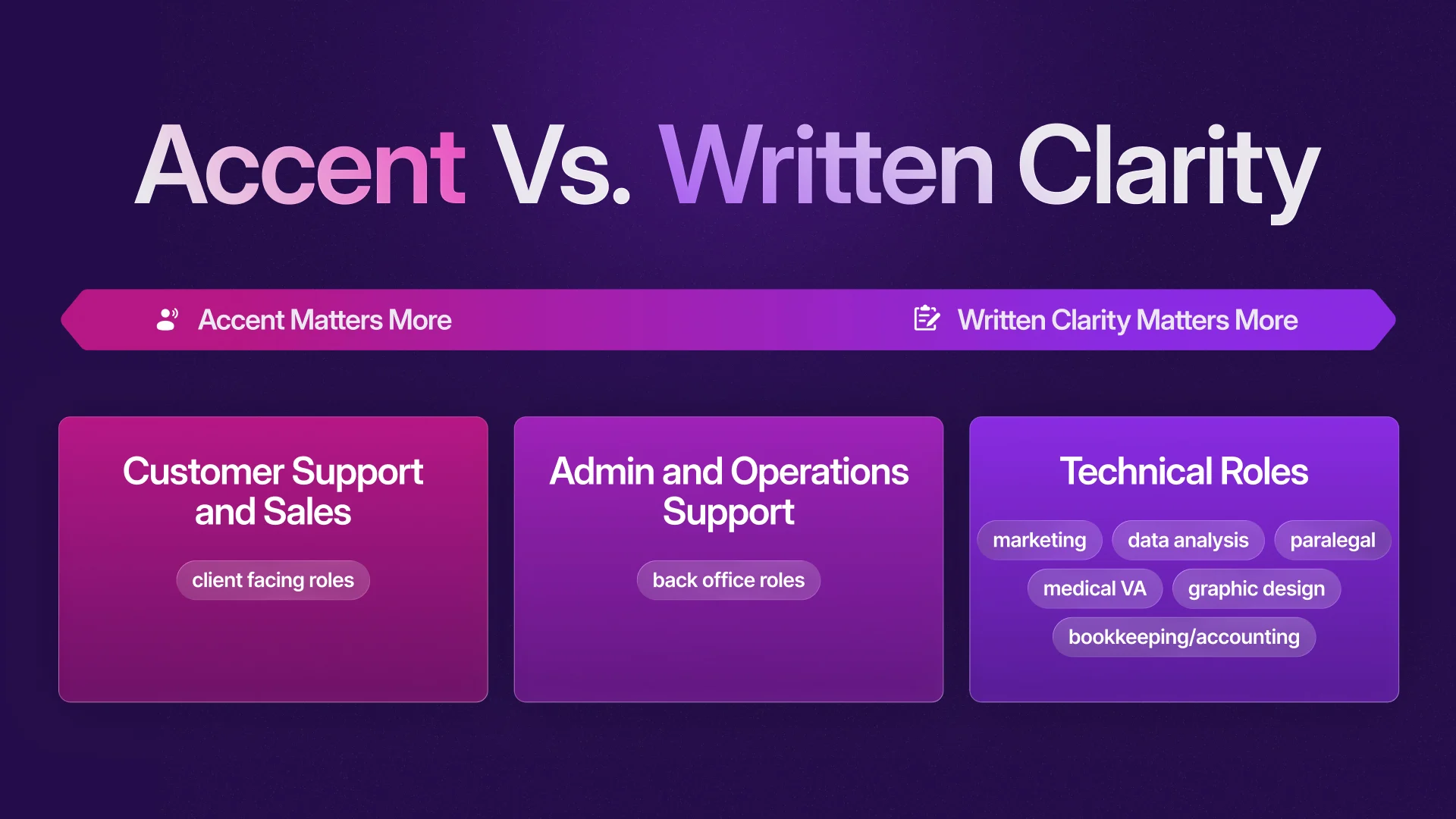
English fluency is non-negotiable, but accent standards vary by role. Written fluency and comprehension matter across every position. Spoken accent matters far more in client-facing roles than it does in back-office or specialized work.
Client-facing roles require near-native spoken fluency. Customer support and sales roles put your business's credibility on the line with every conversation, so the bar for spoken clarity should be as close to an in-house hire as possible.
Back-office roles prioritize written clarity over accent. Administrative and operations support are evaluated on task execution and internal communication, not on how someone sounds in a live call.
Specialized and technical roles care about the deliverable, not the voice. Marketing, legal, medical, and bookkeeping work is judged on accuracy and quality of output. Accent has essentially no bearing on any of it.
Cultural fluency matters separately from accent, especially for embedded roles. Understanding American business norms carries real weight for team-integrated positions like executive assistants or project managers, even when accent isn't a factor at all.
Not all remote roles have the same language requirements, and treating them as if they do is one of the most common mistakes business owners make when they hire a virtual assistant. A customer support rep who stumbles over words in a live call creates a very different problem than a bookkeeper who formats a spreadsheet with the same issue. The stakes aren’t quite the same, the friction isn’t the same, and the vetting standard shouldn’t be the same either.
This handy guide takes a look at where English fluency and accent matter the most, where they matter less, and how to calibrate accordingly, if you plan to outsource virtual assistant work through a virtual assistant agency.
Why English Fluency Is Non-Negotiable Across Every Remote Role
Strong English fluency is a baseline requirement for every remote position. Written fluency is important for email communication, Slack messages, documentation, and handoffs. Comprehension matters for following instructions and flagging any issues that arise. A virtual assistant who can’t communicate clearly in writing will create friction no matter how back-office the role is.
The question isn’t whether English fluency matters…it all comes down to how much accent and spoken clarity need to be evaluated relative to the specific demands of the role. That’s where the real hiring distinction lives, and it’s something that the best virtual assistant companies take seriously when building a candidate pipeline. Proper outsourcing means matching the fluency standard to the role.
Where Accent Matters Most: Client- and Customer-Facing Roles
Customer Support
In a customer support role, your virtual customer service assistant is your business in the eyes of every single person that they speak with. When a customer calls with a billing issue or complaint, the clarity and professionalism of that interaction is what will shape their entire impression of your company. A heavy accent that makes conversation difficult, unnatural or choppy phrasing, or a misread tone can completely erode trust even when the information that’s being given is completely accurate.
Here’s an example of what this looks like. A customer calls to dispute a charge and the support rep responds with something like “I will be raising that to supervisor for you” rather than “I’ll escalate this to a supervisor right away.” The intent is the same, but the phrasing signals a language gap that makes the customer less confident in the business. When you outsource virtual assistant roles in customer-facing positions, the spoken English standard should be near-native fluency with an easily intelligible accent.
Sales
The stakes are even higher when it comes to sales. A virtual sales assistant that’s handling outbound calls, qualifying leads, or running demos needs to command attention and build rapport from the first sentence that they speak. Fluency issues don’t just create awkward moments, they give your prospects an easy reason to disengage, and in a sales environment, disengagement leads directly to lost revenue.
Think about a prospect who asks what makes the service different from what they already use, and the rep responds with a halting, imprecisely worded answer that’s hard to follow. Even a strong pitch loses credibility when it’s delivered with hesitation or language that undermines confidence. For sales roles, the bar should be fluency that’s indistinguishable from a strong in-house hire when you opt to hire a virtual assistant instead.
Where Accent Matters Less: Back-Office Roles
Administrative Support
For a virtual administrative assistant that’s handling calendar management, scheduling, travel coordination, or internal communication, the fluency bar is still high but the accent bar is considerably lower. Since the work is primarily written and internal, what matters more is that the instructions are understood accurately, the responses are clear and professional, and nothing gets lost in translation between the VA and the team.
An administrative hire who has strong written fluency and communicates proactively will function effectively even if their spoken English carries a regional accent. The deliverable in this role is the task itself, and virtual assistant services that are positioned correctly around back-office work prioritize fluency in communication and accuracy in execution over accent every single time.
Operations Support
Operations roles, whether that’s project coordination, process documentation, or workflow management, all share the same dynamic. The work is internal, the communication is largely asynchronous, and the person in the role is evaluated on their ability to keep things moving, not on how they sound in a live conversation. Strong written clarity and comprehension are essential, but a perfectly neutral accent is not.
A strong virtual assistant agency will assess fluency for these roles while matching accent expectations to what the role requires. That’s what it means to outsource virtual assistant support correctly…having aligned standards rather than a blanket requirement, and the kind of approach the best virtual assistant services are built around.
Where Accent Matters Least: Specialized and Technical Roles
The roles in this section, including marketing and design, legal and medical support, and bookkeeping and accounting, have all been grouped together because they share a common dynamic: the deliverable is what gets evaluated, not the voice that delivers it. A marketing campaign, a legal memo, a set of financials, or a data analysis output is judged on quality and accuracy. Accent has essentially no bearing on any of that.
Marketing and Graphic Design
A virtual marketing assistant writing ad copy, drafting email sequences, managing social media calendars, or producing graphic assets is evaluated on the quality of the work itself. English fluency is really important here, because the content that they produce needs to read naturally and hit the right tone for an American audience, but spoken accent is nearly irrelevant. Most of the output is written or visual, and most of the collaboration is asynchronous.
For design roles, the work speaks entirely for itself. Whether you’re working through virtual assistant companies or sourcing independently, accent should carry essentially no weight in the evaluation of a creative or marketing hire.
Legal and Medical Support
A legal virtual assistant that’s handling research, drafting documents, organizing case files, or managing scheduling for a law firm is in a role where precision of language matters enormously, but it matters in writing, not in speech.
The same applies to a virtual medical assistant managing documentation, prior authorizations, or administrative coordination for a healthcare practice. The written English standard must be extremely high in both cases. But whether that person speaks with a regional accent from Mexico, Colombia, or Costa Rica is not relevant at all.
Bookkeeping, Accounting, and Data Analysis
A bookkeeping virtual assistant that’s reconciling accounts, categorizing expenses, preparing financial reports, or running payroll support should be evaluated entirely on accuracy and attention to detail. Their written communication needs to be clear enough to flag any exceptions, ask questions, and deliver summaries.
Spoken accent has no meaningful impact. The same is true for data analysis roles, where the outputs, like reports, dashboards, formatted datasets, and trend summaries, are the main work that needs to be done, and written clarity matters far more than how someone sounds on a call.
Cultural Fluency: The Other Half of Language Fit
Cultural fluency is something completely separate from accent, and it often matters a lot more than people realize when they hire a virtual assistant. It covers American business norms, communication expectations, workplace tone, and the professional judgment that allows someone to function as a true extension of your team rather than a task executor who needs constant direction.
Understanding American Business Norms and Communication
American business communication tends to be direct, action-oriented, and relatively informal compared to norms in many other parts of the world. A VA who understands that a quick Slack message is appropriate where a formal email would feel slow, who knows how to push back constructively rather than silently defer, and who reads the unspoken expectations of a professional interaction is a whole lot more effective than one who doesn’t, regardless of their accent.
Many of the strongest candidates in nearshore Latin America, including Mexico, Colombia, and the Caribbean, have grown up around American media and professional culture. That exposure usually tends to produce a cultural fluency that goes well beyond language and makes integration into an American team feel really natural.
Why It Matters Most for Team-Integrated Roles
Cultural fluency matters most in those roles where the virtual assistant is functioning as an embedded team member rather than a task-based hire. An executive assistant who is a constant presence in the founder’s workflow, a marketing coordinator who attends team standups, or a project manager overseeing other people’s time and priorities all need to operate with a strong sense of American workplace culture. On the other hand, a data analyst who delivers a weekly dashboard or a bookkeeping virtual assistant who sends a monthly reconciliation report has a much narrower team interface, and cultural fluency, while still really valuable, is less likely to be a daily point of friction.
How Rigorous Vetting Prevents Language Friction
The right virtual assistant agency will assess spoken and written English and cultural fluency before a candidate is ever presented to a client. That means structured language evaluations, communication exercises that actually simulate real work scenarios, and a placement process that closely matches the fluency standards to the specific requirements of the role. When virtual assistant services are built with this level of detail, language never has to be a source of friction, whether it’s during a customer call, an internal handoff, or a written deliverable.
For businesses that want to hire a virtual assistant or outsource virtual assistant work nearshore, virtual assistant Latin America talent has grown significantly. Virtual assistant companies across Mexico, Colombia, Costa Rica, and the Caribbean produce highly fluent, culturally aware professionals for every type of role imaginable. What separates a successful outsourcing strategy from one that creates friction is a trusted virtual assistant agency that calibrates the fluency standard to the specific role, not one that applies one single expectation to every position.
Conclusion
Hiring a virtual assistant well means matching the fluency standard to the role, not applying one blanket expectation across every position. The agencies that get this right vet spoken English, written fluency, and cultural fit before a candidate is ever presented, so language becomes a non-issue rather than a daily source of friction.
No. Written fluency and comprehension are essential across every role, but how much spoken accent matters depends heavily on whether the position is client-facing, back-office, or specialized.
Customer support and sales roles require the highest standard, since spoken clarity and rapport directly affect how customers and prospects perceive your business.
Very little. These roles are evaluated on the quality and accuracy of the deliverable itself, such as a financial report, legal document, or marketing campaign, not on how the person sounds on a call.
Cultural fluency refers to understanding American business norms, communication expectations, and workplace tone. It's separate from accent and matters most for roles where the VA functions as an embedded team member.
The strongest agencies use structured language evaluations and communication exercises that simulate real work scenarios, calibrating the fluency and cultural fit standard to the specific requirements of each role before presenting a candidate.
Remote Leverage
Nearshore Staffing Experts
Our research and staffing team places pre-vetted bilingual talent across Latin America and Europe. Every guide is checked against live market hiring rates, compliance requirements, and the workflows our clients actually run.