The Eisenhower Matrix Explained: How Smart CEOs Decide What to Do, Delegate, and Delete
Written by:Remote Leverage
Published:
Updated:
Quick Summary
The Eisenhower Matrix is one of the most battle-tested prioritization frameworks available to founders and CEOs. And not because it organizes a to-do list, but because it forces a deliberate decision about what actually deserves your attention and what is quietly stealing your time.
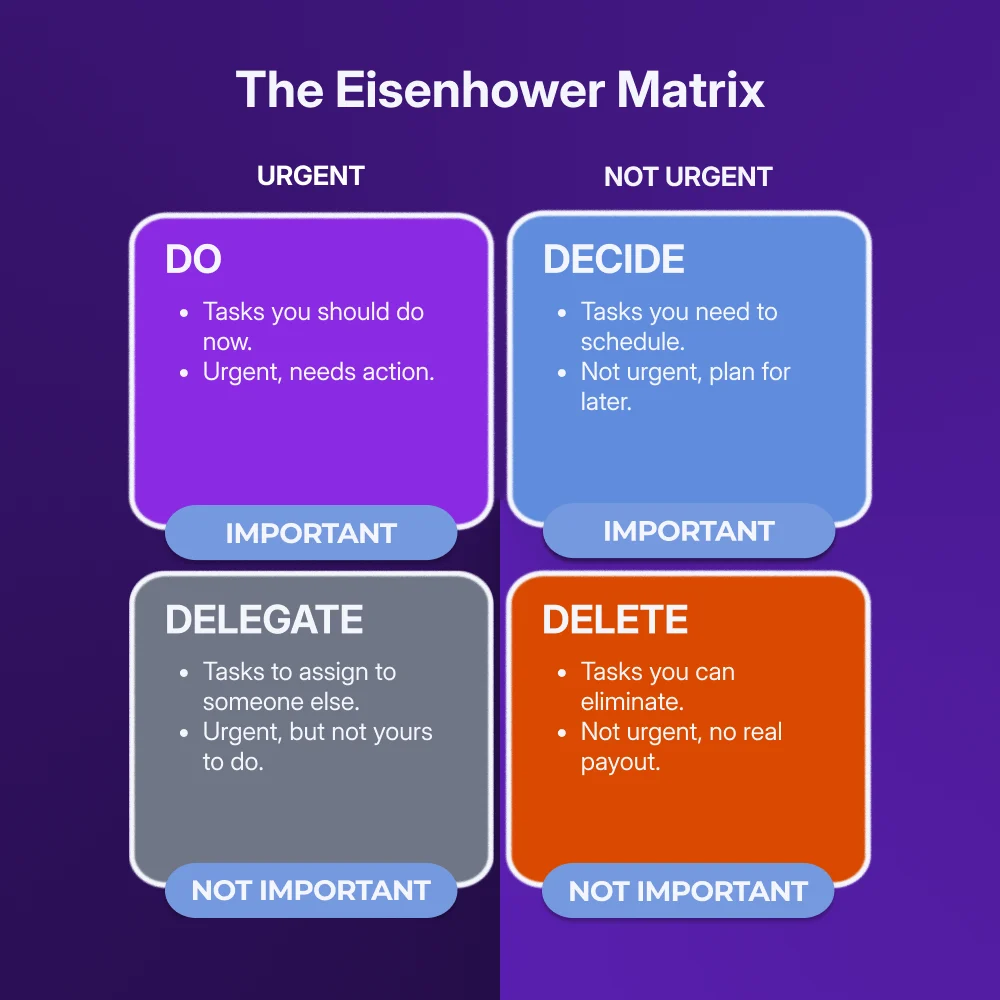
The framework divides every task into four quadrants based on urgency and importance: Do, Decide, Delegate, and Delete.
The framework gives leaders a clear action for every type of work rather than defaulting to whatever feels loudest.
Quadrant 1 – DO – is for genuine crises that require your personal involvement, but if you are spending most of your time here, it is a signal that Quadrant 2 is not getting enough attention.
Quadrant 2 – DECIDE – is where real growth happens, strategic planning, team development, systems building, and relationship investment — and it is the quadrant most founders consistently neglect under daily operational pressure.
Quadrant 3 – DELEGATE – is where most founder time quietly disappears, scheduling, inbox management, data entry, research, and vendor follow-ups are all urgent but do not require your judgment, and are the strongest candidates for VA delegation.
Quadrant 4 – DELETE – tasks includes unnecessary things like unproductive meetings, low-priority emails, aimless browsing, and tasks that feel like productivity without producing anything.
If you’ve ever come to the end of a packed workday feeling like you got nothing important done, the Eisenhower Matrix might be the one of the most useful frameworks that you can try. It’s one of the oldest and perhaps one of the most respected decision making models in the world of leadership and productivity, and for a very good reason. It doesn’t only help you organize your to-do list. It actually forces you to clearly think about the things that truly deserve your attention and those things that are quietly stealing away your time.
For founders and CEOs that are dealing with a ton of different demands, the Eisenhower method can give you something that most productivity systems can’t…a way to make fast, confident decisions about where you should be focusing. This guide fully explains the Eisenhower Matrix, going over everything from how it works to how you can apply it to a real workload. If you’ve been looking for a prioritization framework that helps you boost productivity and finally get ahead of the reactive cycle, you’ve definitely come to the right place.
The Origin of the Framework and Why It Still Works
What is the Eisenhower Matrix, and where did it come from? The framework gets its name from Dwight D. Eisenhower, the 34th President of the United States and Supreme Commander of Allied Forces in World War II.
Eisenhower was famous for his ability to manage an almost incomprehensible volume of decisions across multiple different high-stakes areas. He is widely credited with the core idea behind the framework, which is that what is important is seldom urgent, and what is urgent is seldom important.
That insight became the foundation of one of the most long-lasting prioritization tools in modern leadership. Stephen Covey later popularized the matrix format in The 7 Habits of Highly Effective People, introducing the four-quadrant structure that most people are most familiar with today.
Decades later, the Eisenhower prioritization matrix is still one of the most battle-tested decision making models that’s available to high-output leaders because it addresses a problem that hasn’t changed…how to decide what actually matters when everything feels urgent.
The Four Quadrants Explained in Plain English
You can picture the Eisenhower Matrix as a simple grid that’s been divided into four quadrants based on two variables: urgency and importance. Urgency refers to how soon something needs to be handled. Importance refers to how much it contributes to your goals, your responsibilities, or the long-term health of your business.
Each quadrant calls for a different action.
Quadrant 1 tasks are both urgent and important: handle them now.
Quadrant 2 tasks are important but not urgent: decide when to schedule them.
Quadrant 3 tasks are urgent but not important: delegate them.
Quadrant 4 tasks are neither: eliminate them.
Getting the Eisenhower Matrix explained this clearly is often the first step toward actually using it. The challenge is applying it on a regular basis when all of your daily pressure makes everything feel like it belongs in Quadrant 1.
Why CEOs and Founders Swear By It
The reason that the Eisenhower method resonates so strongly with founders and CEOs is that it directly addresses the pattern that keeps most of them stuck. When you’re running a business, there’s an almost constant flood of requests, problems, and tasks that are always arriving at your door. Without a clear framework for being able to sort through them, you end up reacting to whatever is the loudest instead of focusing on what matters most.
The Eisenhower prioritization matrix changes that dynamic. It gives you a structured way to step back from all of the noise, categorize what’s in front of you, and make a deliberate decision rather than a reactive one. It’s one of the most effective prioritization techniques available because it cuts through all of the complexity and gives you a clear action for every type of task, which is also what makes it one of the most practical answers to how to be more productive as a leader.
Quadrant 1 – Do: Urgent and Important
What Belongs in Quadrant 1?
Quadrant 1 is specifically reserved for things that genuinely can’t wait and that only you can handle such as:
An important client relationship that’s at risk.
A legal or compliance issue that needs immediate attention.
A crisis that could affect your team or operations.
A critical deadline that’s hours away.
These are the situations where your personal involvement is very important and where any kind of delay can create some very real consequences.
Not everything that feels urgent actually belongs here. Pressure and urgency are not the same thing. A task can feel urgent because someone is pushing for it, but that doesn’t automatically make it important enough to demand your immediate attention.
How to Recognize a True Crisis vs. a False Alarm
A true Quadrant 1 task meets two criteria:
a real and near-term deadline
meaningful consequences if you personally don’t handle it yourself
If you remove either of these conditions, the task probably belongs somewhere else in the Eisenhower Matrix.
One of the most common time management challenges that many founders face is treating every urgent-feeling item as a genuine crisis, which leads to a workday that’s constantly reactive. Learning to distinguish between a true crisis and a false alarm is one of the most valuable skills that the Eisenhower method can help develop, and it gets easier the more consistently that you apply it.
How to Reduce the Amount of Time You Spend Here
The goal isn’t to eliminate Quadrant 1 entirely. Real crises happen and need to be handled. But if you’re spending the majority of your time here, something upstream isn’t working. It usually means that Quadrant 2 isn’t getting enough attention, which is causing smaller problems to escalate into genuine emergencies.
The best way to reduce your Quadrant 1 load is to properly invest in Quadrant 2 consistently. Leaders who build strong systems, proactively delegate tasks, and set aside the proper amount of time for strategic planning, find that fewer things end up reaching crisis level. They’re not less busy. They’re just busy with different things.
Quadrant 2 – Decide: Important but Not Urgent
Why Quadrant 2 Is Where Real Growth Happens
If Quadrant 1 is where you survive, Quadrant 2 is where you grow. This is the place for strategic planning, building relationships, developing your team, improving your systems, and the kind of thinking that helps shape the direction of your business. None of these things are on fire, and that’s exactly why they often end up getting neglected.
Quadrant 2 is the most important part of the Eisenhower Matrix for founders who want to lead strategically. The work here doesn’t create urgency, but it’s the work that prevents urgency from taking over your schedule. Decide when to schedule these tasks so they get done.
Leaders who protect their Quadrant 2 time find that their Quadrant 1 load shrinks as time goes by, because they’ve built the systems and relationships that stop problems from turning into crises.
What Most Founders Neglect by Staying in Quadrant 1
When Quadrant 2 gets neglected, the effects are usually slow but significant. Strategic planning gets pushed to “later on” when things calm down, which never seems to arrive. Team development completely stalls. Systems don’t ever get built. The relationships that matter most get sporadic attention. And all of these eventually create new Quadrant 1 emergencies.
This is one of the most important insights the Eisenhower Matrix offers: the best way to spend less time in crisis is to invest more time in the work that prevents it. Most founders understand this intellectually, but the pressure of running a business makes it easy to deprioritize. Applying the Eisenhower prioritization matrix consistently is what breaks that cycle.
How to Protect Time for Strategic, High-Value Work
Protecting Quadrant 2 time means treating it with the same commitment you’d give a Quadrant 1 crisis. Block it on your calendar. Don’t let it get bumped by lower-priority requests. And build the delegation systems that keep Quadrant 3 tasks from landing in your lap and disrupting your focus.
The founders who get the most from the Eisenhower method know that Quadrant 2 doesn’t protect itself. That means using the right prioritization tools, building strong delegation habits, and making deliberate decisions about where your time goes.
Quadrant 3 – Delegate: Urgent but Not Important
What Belongs in Quadrant 3
Quadrant 3 is where a lot of founder time goes without founders realizing it. These are tasks that feel urgent because they’re sitting in front of you and seem to need a response, but that don’t actually require your specific judgment, expertise, or authority. Scheduling and calendar management. Inbox handling and routine email responses. Research requests. Meeting preparation. Data entry and basic reporting. Travel coordination. Vendor follow-ups.
These tasks have a time component, but they don’t need to be completed by you. They just need to be completed. That distinction is the core insight behind Quadrant 3, and it’s where the Eisenhower Matrix becomes most directly actionable for founders trying to reclaim their time.
Why Founders Struggle to Let Go of These Tasks
Founders most often struggle to delegate tasks from Quadrant 3 because of the belief that it’s faster to handle things themselves. In the short term, that’s often true. Handing something off requires documentation, communication, and trust, and when you’re busy, those things feel like additional work rather than investments.
Many founders have built their identity around being the person who handles everything. Letting go of Quadrant 3 tasks can feel like a loss of control, even when those tasks are low-value work that should be someone else’s job. This is one of the most significant time management challenges in making the shift from operator to strategic leader.
How a Virtual Assistant Handles Quadrant 3 So You Don’t Have To
This is where a virtual assistant becomes one of the most powerful prioritization tools available to a founder. A great VA is specifically suited to Quadrant 3 work: it’s urgent enough to need timely handling, but it doesn’t require your personal involvement. Your VA can manage your inbox, coordinate your calendar, handle research, prepare reports, follow up with vendors, and manage recurring administrative tasks without pulling you away from the strategic work that only you can do.
When you delegate tasks from Quadrant 3 to a capable VA, you’re not just getting hours back. You stop being pulled into low-value urgency and start having the space to protect Quadrant 2. That’s how the Eisenhower Matrix goes from being an interesting concept to a system that actually changes how you operate.
Quadrant 4 – Delete: Not Urgent and Not Important
What to Eliminate From Your Schedule Immediately
Quadrant 4 is the easiest to describe, but for so many people it’s one of the harder ones to actually act on. These are the tasks that don’t move anything important forward and don’t have any real urgency attached to them. These include things like unnecessary meetings without any clear agenda, checking social media during work hours, responding to low-priority emails that don’t need a response, reorganizing files that are already well organized, browsing without a specific purpose.
These activities still occur because they’re easy, because they feel like productivity even when they aren’t, or because they offer you a bit of a mental break. But they’re time that could be redirected toward Quadrant 2, where it would compound into something a whole lot more meaningful.
How to Identify Tasks That Feel Productive But Aren’t
One of the most valuable skills that the Eisenhower method builds is the ability to recognize fake productivity…those tasks that give you the sensation of being busy without you actually getting anything accomplished. This could be things like formatting a report that didn’t need formatting, attending a meeting where your presence made no real difference, or tweaking a slide deck instead of preparing the thinking behind it.
The test for this is simple…if you removed this activity from your week entirely, would anything important be worse off? If the answer is no, then it’s definitely a strong candidate for Quadrant 4. Applying that test on a regular basis is one of the most effective task prioritization techniques that a founder can develop, and it’s what separates reactive operators from strategic leaders.
Building the Habit of Saying No
Quadrant 4 management isn’t just about eliminating tasks. It’s also about preventing them from landing on your schedule at all. That means saying no to requests that don’t align with your priorities, declining meetings that don’t require your input, and building a culture where not every question funnels through you.
Saying no is a skill, and it gets easier when you have a clear framework to reference. When someone asks for your time, the Eisenhower Matrix gives you an objective way to evaluate that request rather than just defaulting to yes, as so many people tend to do. That’s one of the reasons it’s still one of the most respected decision making models for high-performing leaders today.
Once you understand what is the Eisenhower Matrix and how its four quadrants work, the most effective way to put it into practice is a weekly audit. At the start of each week, take fifteen minutes to list everything on your plate and sort each item into one of the four quadrants. A list with four sections is enough to get started.
As you sort through everything, ask two questions for each item:
Is this actually important to my goals?
Is this actually time-sensitive enough to require immediate attention?
The answers will often surprise you. Tasks that felt essential will reveal themselves as Quadrant 3 or Quadrant 4 items, and the strategic work you’ve been putting off will become visible as the Quadrant 2 priority it actually is.
Common Mistakes When Applying the Framework
The most common mistake when using the Eisenhower method is treating urgency and importance as the same thing. When everything feels urgent, the quadrants collapse.
In order to fix this, you have to be honest about what is actually important, meaning what genuinely advances your goals versus what just feels pressing because it’s directly in front of you.
Another common mistake is treating the Eisenhower Matrix as a one-time exercise. It only works if you apply it on a regular basis. A single audit can be really useful, but it’s the weekly discipline of sorting, scheduling, delegating, and eliminating that is actually going to change how you spend your time. Like all effective prioritization techniques, it requires practice before it becomes automatic.
How Delegation Tools and VAs Make the Matrix Actionable
The Eisenhower Matrix is a thinking tool, but its real power comes from what you do with the output. Once you’ve identified your Quadrant 3 tasks, you need somewhere to send them. That’s where being able to delegate and having the right support structure become really important. The Eisenhower Matrix explained without a delegation system in place, is just a categorization exercise. With one, it becomes a genuinely better way to operate.
A virtual assistant is one of the most practical prioritization tools for making Quadrant 3 delegation happen. When you have a capable VA in place, sorting tasks into Quadrant 3 becomes a direct course of action rather than a deferred intention.
You don’t just note that something should be delegated. You hand it off, and it gets done. That’s the difference between a framework on a whiteboard and one that helps you boost your productivity in a way that sticks around for the long-term.
Remote Leverage matches founders with top-tier virtual assistants from Latin America who are experienced, highly communicative, and are ready to hit the ground running. If you’re wondering what is the Eisenhower Matrix worth in practice, the answer is this…it becomes genuinely powerful when you have the right people in place and systems to act on it. The Eisenhower prioritization matrix gives you a clear vision, while a great VA gives you the ability to act on it.
Conclusion
The Eisenhower Matrix does not make your workload smaller. It makes your decisions about that workload clearer. The difference between a founder who is constantly in reactive mode and one who is consistently moving the business forward is rarely about effort. It is about knowing which work deserves their time and having the systems to redirect everything else.
Quadrant 3 is where that shift becomes practical. Once you can clearly identify the tasks that are urgent but do not require your personal involvement, delegation stops being a vague intention and becomes a direct action. A virtual assistant is what turns that action into a reliable system, one that keeps Quadrant 3 off your plate permanently so you can protect the Quadrant 2 time that actually compounds into growth.
FAQs
It is a four-quadrant prioritization framework that sorts tasks by urgency and importance: Do, Decide, Delegate, and Delete. It’s designed to help leaders make deliberate decisions about where their time goes instead of reacting to whatever feels most pressing.
The framework is credited to Dwight D. Eisenhower and was later popularized by Stephen Covey in The 7 Habits of Highly Effective People. The core insight, that what is important is seldom urgent, and what is urgent is seldom important, remains as relevant today as ever.
Quadrant 2 is important but not urgent, that’s where strategic growth happens. Most founders underinvest here because daily urgency crowds it out, but protecting this time is what reduces Quadrant 1 crises over time.
Scheduling, inbox management, data entry, research, vendor follow-ups, meeting preparation, and routine reporting. This is work that is time-sensitive but does not require your personal judgment or authority.
A VA makes Quadrant 3 delegation immediately actionable. Instead of noting that something should be handed off, you hand it off and it gets done, turning the matrix from a categorization exercise into a system that actually changes how you operate.
Turn each Quadrant 3 task into a written manual and a short video walkthrough, then hand it off with clear standards and regular check-ins. This guide explains how to delegate any task to a virtual assistant.
Remote Leverage
Nearshore Staffing Experts
Our research and staffing team places pre-vetted bilingual talent across Latin America and Europe. Every guide is checked against live market hiring rates, compliance requirements, and the workflows our clients actually run.